The new post-AI standard for hiring
Stori turns interviews from unstructured conversations into evidence-linked candidate intelligence. Built on a century of behavioral science and eight years of independent research, our patent-pending methodology replaces outdated competency-based interviews with a new framework of questions and traits.
Our Founding Principles
For over sixty years, hiring has relied on the same behavioural competency interview. We went back to first principles and rebuilt it.
By replacing competency-led questioning with structured narrative, Stori reconstructs experience the way people actually remember it.
In almost every real hire, several people could do the job well. The task is not to find the single best person - that person is a myth - but to decide who is worth serious consideration. Nobel Prize winner Herbert Simon named the constraint every hire runs under: bounded rationality. We never have all the evidence, nor the time to weigh it with certainty, so no one optimizes - we choose a candidate who clears the bar, and stop. No assessment can see the new manager, the reorganization, or the market shift that will actually shape how someone performs. Future performance is unknowable, so we do not pretend to predict it.
Hiring is a probabilistic decision, not a predictive one - and the goal is not certainty, but better evidence.
Organizations expand competency frameworks as though performance becomes more measurable the more categories they add. But more categories mostly add overlap, not insight. Additional competency labels are often mistaken for additional precision.
Fewer, clearer constructs are more honest than many vague ones.
The first question in any hire is whether someone is capable of work at this level of complexity. General cognitive ability - g - is among the most consistently replicated predictors of performance in behavioural science, and it matters more as the work grows more demanding.
This is not about hiring the smartest person in the room. It is about being capable enough for the work in front of you.
Performance resolves, again and again, to four enduring capabilities: how someone thinks, how disciplined they are, how they communicate, and how they execute. These are not arbitrary categories. Discipline is conscientiousness by another name; the Big Five sits beneath them. Every role needs all four - only the proportions change.
A small number of capabilities does almost all the work.
People remember their careers as stories - the people, decisions and turning points - not as tidy examples of competencies. Behavioral competency interviews ask for named competencies on demand as if memory were filed like an assessment framework. This is the wrong way to get the most out of candidate interviews.
Assessment should align with how memory actually works.
Resumes, interviews, stories, simulations and references - none of these is the thing we are trying to understand. Each is only a window onto the capabilities beneath. A simulation is not valuable because it is a simulation; a story is not valuable because it is a story. They matter only to the extent they reveal how someone thinks, executes, communicates and applies themselves.
Improve the evidence and you improve the judgement - you do not replace it.
Resumes capture history. Interviews capture moments. Assessments capture abstractions.
Candidate Intelligence unifies narrative evidence, structured assessment, and behavioral patterns into one layer that can be searched, compared, and corroborated over time.
Four meta-traits. Twelve facets. One unified language.
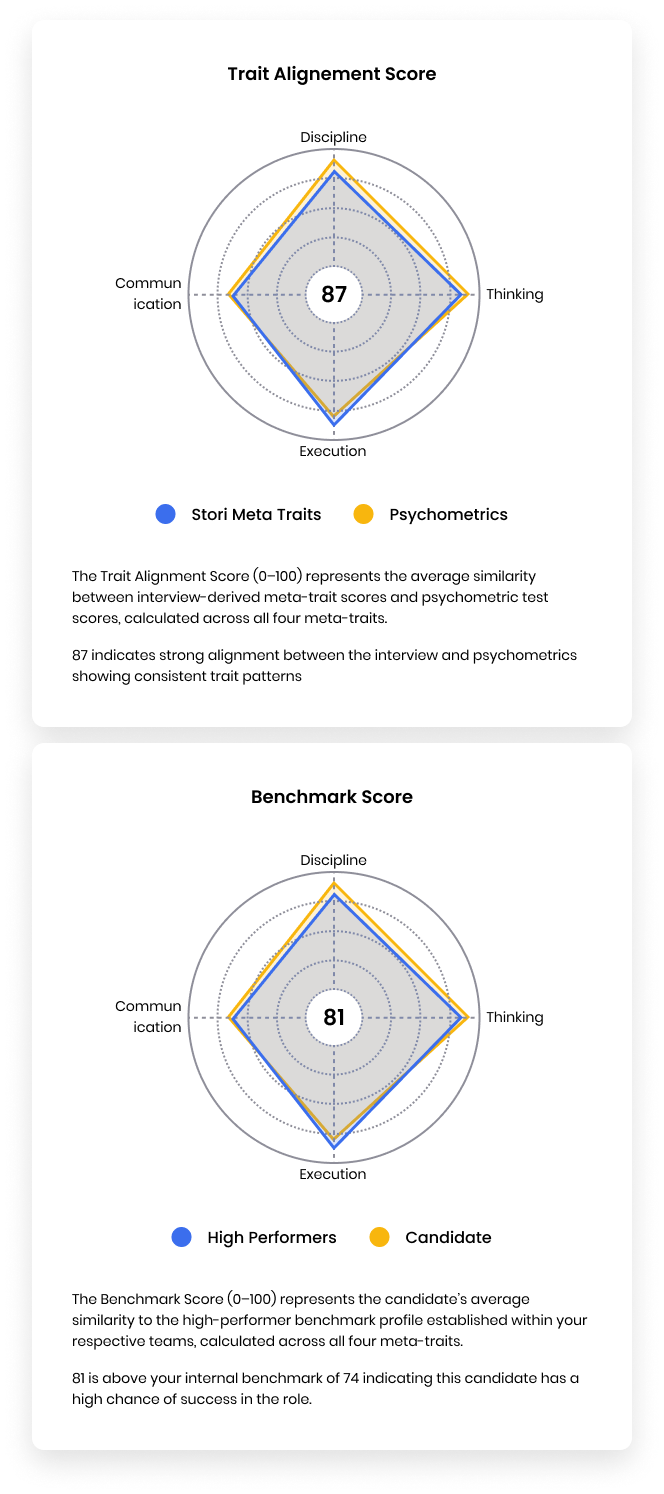
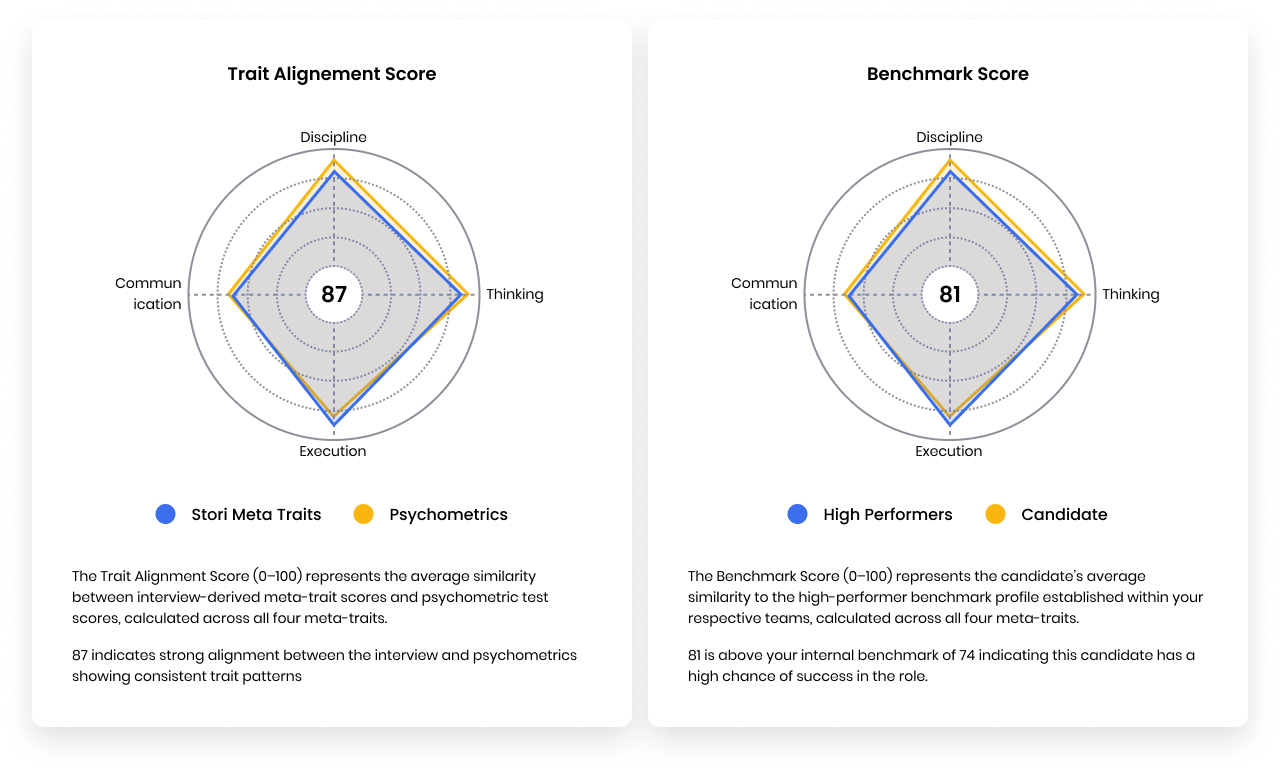
Every candidate is interpreted through a common language of four meta-traits and twelve facets — but Stori keeps the evidence sources separate: the 120-adjective trait assessment captures self-perception, while the interview captures evidence drawn from the candidate's narrative. The same facets appear in both, so the two can be compared without being collapsed.
Thinking
How a person explores ideas, processes information, and generates insight.
Discipline
How a person sets standards, maintains reliability, and sustains effort.
Execution
How a person acts under pressure, manages risk, and delivers outcomes.
Communication
How effectively a person conveys ideas, moves others to action, and navigates interpersonal dynamics.
How Stori Weighs Evidence
4,000-word transcripts carry far more context than 400-word AI resumes. Because interview evidence contains more context than resume keywords, Stori gives greater weight to demonstrated narrative evidence once it is available. This doesn't make the system perfect — it makes the reasoning more inspectable, because every assessment claim is tied back to specific transcript evidence.
Layer 0: Eligibility filters
Location, work authorization, required qualifications. Rule-based fit, not assessment.
Layer 1: Resume intelligence
Experience, skills, education, company history. A useful proxy, not direct evidence.
Layer 2: Interview intelligence
Narrative evidence from what the candidate says they did, decided, built, learned and changed. Richer context than resume data.
Layer 3: Cross-validation
Comparison between self-reported traits and interview-observed patterns. Agreement increases confidence; disagreement becomes a self-awareness signal where the evidence supports it.
Research-grounded trait assessment
Stori builds on established personality research and the IPIP lexical framework to develop an assessment based on behavioral traits, not just experience.